
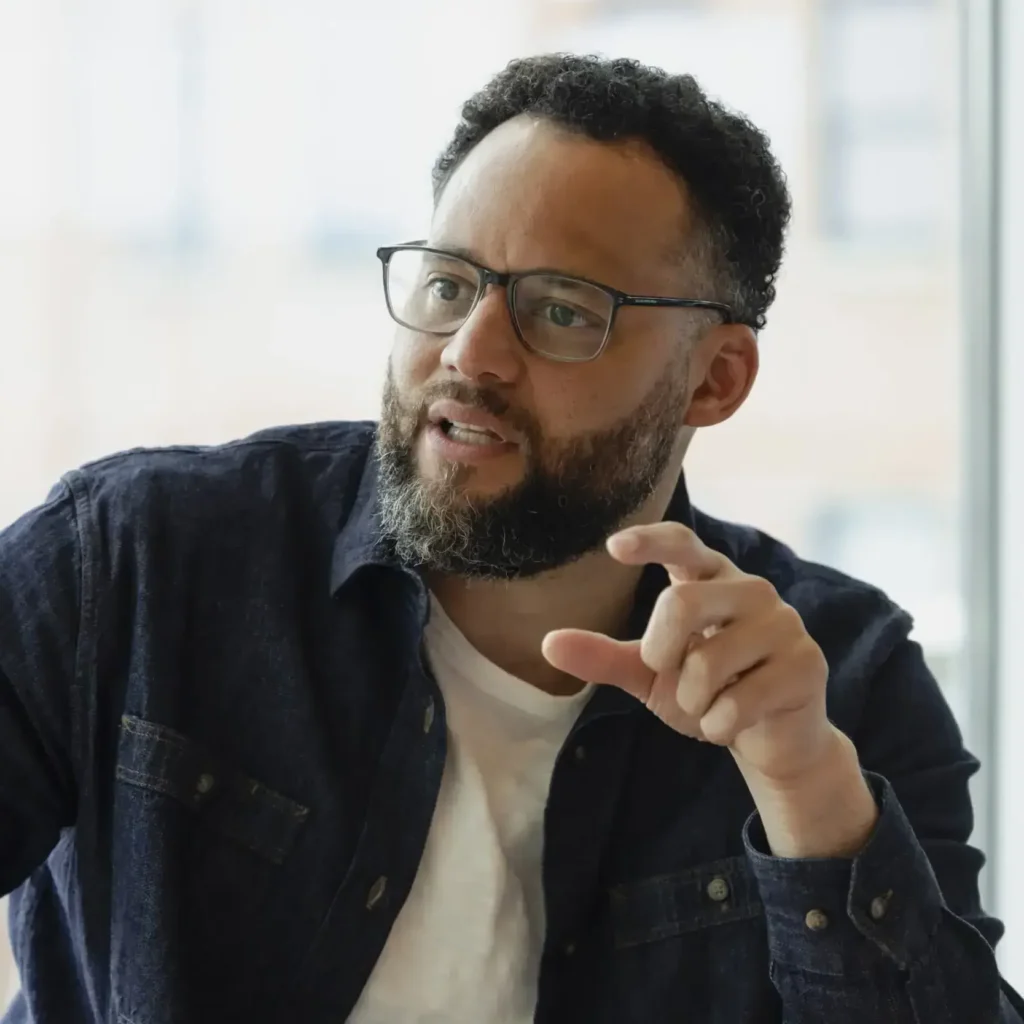
These questions were offered from Ms. Doris Crenshaw, a civil rights leader who, at fifteen, stood at Rosa Parks’s side in the lead-up to the Montgomery bus boycott and who has spent the decades since telling the truth to whoever is in the room with her. I met her this year in Montgomery, Alabama, where I found myself twice in the span of a few months. The first visit was with a national community of funders, and the second was with our own Brilliant Leaders. Both visits pushed me to pause and reflect on how our history could/should/does inform our understanding of where we are now and where we are headed. Ms. Doris’s questions have stayed with me, and this year, at least for me, they’ve become something of a guide for the Foundation: a way of returning, again and again, to clarity and purpose amid work that resists easy answers.
Those questions sit alongside another idea I picked up this year from Carmen Rojas: that memory and imagination are tied together. Not a “manufactured memory” that relies on negationism—the denial and distortion of historical truth—but a real unflinching look at our collective history of both struggle and resistance. Leaning into this collective memory of resistance creates the space to imagine vastly. I’ve come to think of these two ideas as being in productive tension with one another—the discipline of knowing exactly what we’re here to do, held together with the expansiveness required to imagine something we have yet to build. This productive tension has shaped our approach: specific enough to act and bold enough to matter.
This has also been a year of asking harder questions about our own systems—not just whether they’re faster or cleaner but whether they’re actually ours. GEO gave me a helpful frame for this: PTR. Is it a preference? Is it a tradition? Or is it actually required? So much of what organizations and systems carry forward is simply preference or tradition mistaken for necessity. Sorting out the difference has shaped how we’re rethinking our grantmaking infrastructure this year, work that will show up more fully in the year ahead.
It has not escaped me that we do this work as our country marks 250 years since its founding, a milestone that invites both celebration and honesty. Baratunde Thurston said something at the PolicyLink Conference this year that has stuck with me: “We can’t love a country we don’t know.” Loving this place and building the democracy we still aspire to requires knowing our full history, not a curated version of it. That is true of nations, and it is true of the families and communities we work alongside. Real love, real progress, requires sitting with complexity rather than smoothing it away.
Nowhere has that complexity been more present for me than in our Investment in Families Initiative. The easy story is the one with a clean before-and-after year over year: a job gained, a credential earned, a milestone hit. Those things matter, and they are happening. But the truer story is less tidy and it is more fluid as the 10-year project enters year three already. It’s the felt difference families describe when they are seen, trusted, and treated as the experts in their own lives. It’s the sense of community and circle of support that has uplifted and guided the family leaders in their respective journeys. It is not one intervention. It is hundreds of decisions, made with care and intentionality, over and over and over again by them and a whole network of people, organizations, and families. That is harder to put in a headline. It is also, I believe, the actual work.
So: why are we here? To build the kind of community, and the kind of democracy, we say we believe in, one that holds both the specificity of the assignment in front of us and the vastness of what we’re still imagining together. And what’s the assignment? To keep asking that question, honestly, and to keep showing up for the answer.
Thank you for being in the room with us.
Daniel Williams, EdD